The beginning
The origins of fear
The noise before the void. The noise of the helicopter covered every thought.
It was not a simple noise: it was a continuous vibration that entered the bones, made the ribs tremble, broke the rhythm of breathing.
Below him, the Marmore Falls roared like an ancient, impatient creature. The water fell with primordial force, indifferent to men, to their challenges, to their shows.
Haldin was suspended in the void.
Bound.
Still.
Wrapped in a straitjacket that pressed his arms against his chest.
The wind slapped his face.
The metallic smell of altitude mixed with that of the nebulized water rising from below. Each oscillation of the cable made him rotate slowly on himself, like a human pendulum above the white roar.
Down there there was no stage.
There were no wings.
There was no possibility of pretending.
There was only time.
And time, when you are tied in the void, does not flow: it expands.
Someone on the ground was counting the seconds. Someone else was holding their breath.
Not him. He had to do the opposite: control his breathing, slow it down, make it an ally.
Every great escape begins in the same way: with a silent question that no one hears. "What if this time it's not enough?"
Many years later, on the threshold of old age, Haldin would try to explain why he did it.
He would speak of discipline, of training, of technique. He would hint at the audience, the adrenaline, the perfection of the gesture. But the truth was simpler and more uncomfortable.
Even before learning to free himself from chains, he had learned to inhabit fear.
And everything had begun far from that helicopter. Long before the cameras.
It had begun in Terni, long before the cameras. Long before the handcuffs.
At nine years old, Haldin did not yet know what claustrophobia was.
He only knew what adventure was.
He lived on the outskirts of Terni, where the last houses gave way to the countryside and the hills began to rise towards the mountain range that closes the north of the city.
It was enough to cross, at some fordable point, the small stream that the boys called "la Forma dei Cavalli" and the world changed substance.
It was the perfect territory to feel like explorers, conquerors of worlds invisible to adults. That day there were three of them.
They climbed up to the hill everyone called Colle dell'Oro. Not for real gold, but for that warm color the earth took on at sunset. They were playing at discovering unexplored territories when they saw it: a narrow crack in a rock face. A dark, vertical cut, wide enough for a thin child and narrow enough to make an adult hesitate.
Courage, at nine years old, is almost always recklessness.
"I'm going in," he said. His friends leaned into the entrance, like sentinels. They encouraged him. Or at least he thought they were.
The first steps were simple. Light still filtered through.
Then the crack turned left. The darkness came without warning. He had to lean on the rock with his hands to orient himself.
The wall was cold, damp.
Maybe he turned right. Maybe left again.
He wouldn't have been able to say for sure even years later.
At some point, the darkness was no longer absence of light. It was presence.
He turned to go back. He quickened his pace. Almost ran. He ran into the rock. It was not the exit.
His breathing changed rhythm. He shouted his friends' names. The answers came, but they seemed to come from far away... or perhaps from behind him. The sound bounced, deceived. Space had deformed.
It was not yet the thought of death. It was not the awareness of not making it. It was pure terror. Primitive. Formless.
They would later say he stayed in there for almost an hour. An hour wandering in the dark, feeling walls that seemed to close in, breathing air that became heavy in his head.
Then an adult voice. Different. Confident. A light.
A neighbor, alerted by his friends who had fled shortly after the exploration began, entered with a flashlight. He reached him, took his shoulder, led him out.
Daylight had never been so violent.
That was when claustrophobia was born. Not a simple annoyance. A silent presence, always ready to re-emerge.
Yet, years later, that very fear would become his laboratory. Every closed chest. Every straitjacket. Every immersion.
They were not challenges to the public. They were challenges to that child left in the dark.
The phobia is under control today. It has never disappeared. And perhaps that is the secret.
Claustrophobia does not only strike in the dark. It does not need caves or rock walls.
In the 1960s, one of the most widespread cars was the small Fiat 500. A compact utility vehicle, two front doors, folding seats to allow rear passengers to get out. It was a practical solution, normal for the time.
Normal, until you find yourself in the back.
Haldin was just over nine years old when he found himself sitting in the back seat. The adults in front were chatting. The car was stopped, perhaps parked for a few minutes. An insignificant detail in the memory of those sitting at the wheel.
But he couldn't open the door. To get out, the driver or passenger would have had to get out, move the seat, free the passage.
He was dependent on that gesture.
At first it was just a thought. Then the thought took shape. He tried the handle. Useless. He looked at the glass. Too small to be an escape. Suddenly the space shortened.
He was not in the dark. He was not underground. He was not alone. Yet the feeling was the same as the crack on the hill.
His breathing became short. A silent roar began to rumble in his head - as if something was collapsing inside, making no noise outside.
The adults in front noticed nothing. Claustrophobia has this cruel thing: it is invisible to others. It squeezes you while the world continues to talk about insignificant things.
When finally the door opened and the seat was lowered, he got out too quickly. He said nothing. He didn't want to explain. But he had understood one thing: it wasn't the dark that frightened him. It was dependence. The impossibility of deciding alone when to leave.
Many years later, every chain, every straitjacket, every closed chest would have only one rule: the key, somehow, had to be in his hands.
— end of chapter —
How he became a 'magician'
Rhythm and hands.
Before the chains there was rhythm. Haldin's adolescence did not immediately involve padlocks or closed chests. It involved drums, drumsticks and evenings in smoky clubs where music covered insecurities. He joined a band. He played the drums.
Behind that drum kit there was something that reassured him: control of time. Rhythm doesn't betray you. If you master it, it supports you.
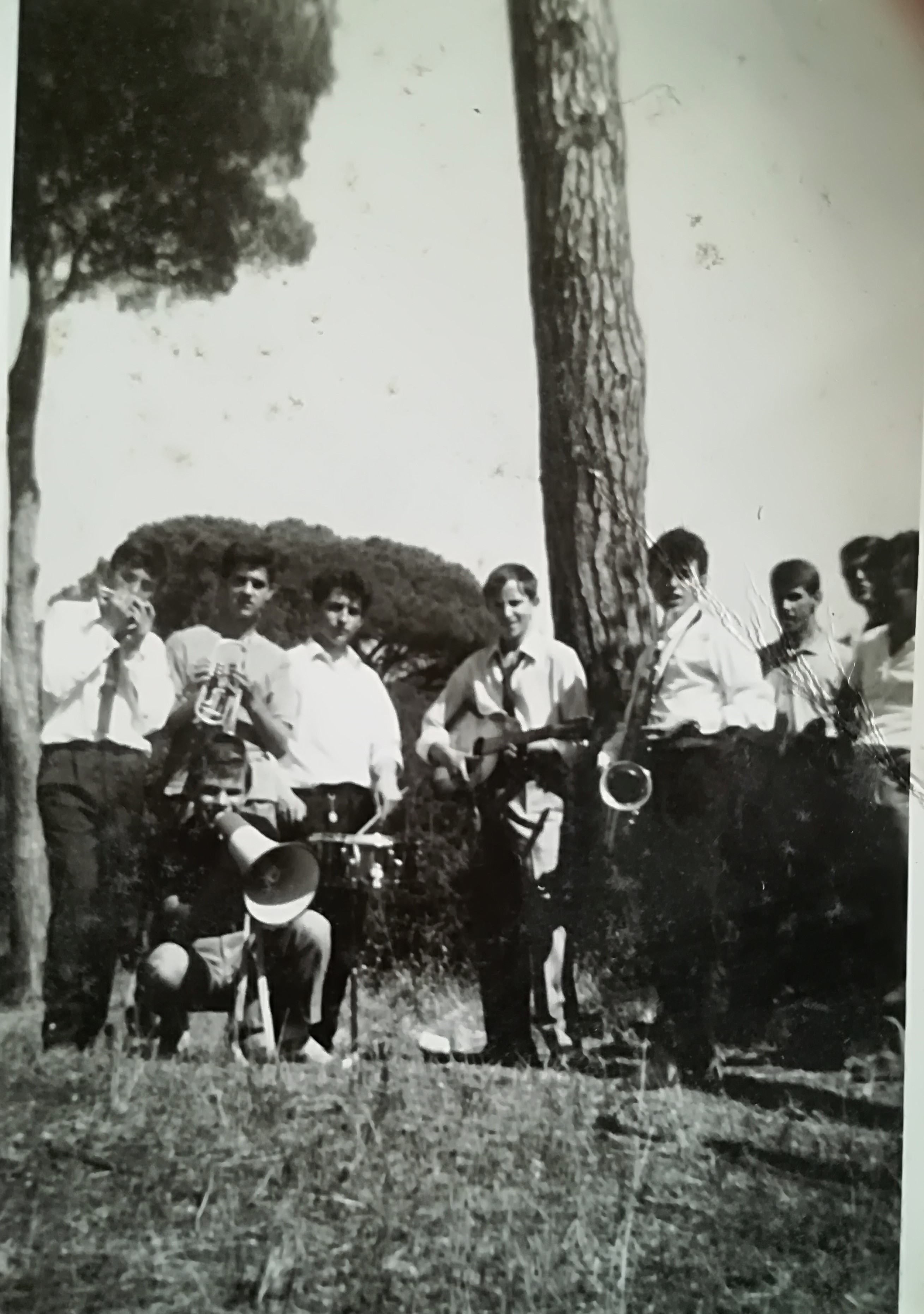
the orchestra...
They went around clubs, parties, dance halls. They weren't famous artists, but they had an audience. And the audience, even when you don't know it, educates you. It puts you in front of gazes, accustoms you to judgment, forces you to withstand the impact.
While the drumsticks marked time, the hands did something else. He dabbled in manipulation. Cards, coins, small objects that appeared and disappeared between his fingers. It wasn't yet a profession. It was a natural talent, one of those silent gifts that nature gives without explanation.
The drums trained the body. Manipulation trained control. And above all, the stage stopped being scary.
Many years later he would understand that those evenings in clubs had been his first real school of showmanship. Not that of magic, but that of the gaze. The habit of being in front of people, hearing the buzz die down, perceiving when all attention is on you.
December 31, 1968
The orchestra's pianist — the one who also took care of procuring engagements — arrived one day with a flyer in his hand.
"New Year's Eve Gala - December 31, 1968 - Hotel Park in Orte - with the extraordinary presence of magician Orion."
Haldin looked at it. "Who is magician Orion?" The pianist smiled. "It's you."
There was an instant of emptiness. Not the void of the helicopter. Not the darkness of the cave. A different void: that of identity that changes without asking your permission.
Paralyzed. The same ancient fear, but disguised as a stage.
He had never done a complete show as a conjurer. A few numbers between one piece and another, yes. Small informal performances among friends or family. But a New Year's Eve gala, with a stage name printed on a flyer, was something else. Orion.
That evening, at the Hotel Park in Orte, he went on stage with fear clenching his stomach. But the drums had taught him one thing: rhythm goes on even when you tremble.
The show worked. Not perfect. Not without tension. But it worked. And sometimes a success is enough to change a life.
From that day he gradually stopped playing. Music remained a love, but no longer the center. The art of prestidigitation took over. Study, rehearsals, mistakes, refinement.
The stage was no longer a place to fear. It was a place to conquer.
His television debut would come in 1977, in front of the wild power of the Marmore Falls. But that's another story.
After that first evening, the idea of a definitive stage name began to take shape. Orion was suggestive, fascinating... but it didn't really belong to him. He was looking for something that could be a bridge between his identity and the artist he was becoming.
He looked at his surname: Aldini. With a small touch, a few syllables shifted, Haldin was born.
It wasn't just a name. It was the symbol of a transition: from the fearful boy, who had known darkness and control, to the magician and escapologist who would challenge fear in front of the public and cameras.
Haldin would carry with him the entire story that had formed him, but he would also have the freedom to become a legend.
— end of chapter —
The challenge at the waterfall
The cold was a dry blow...
From 1968 to 1977 Haldin's life was a bridge between music, his first prestidigitation shows and the obsession with extreme challenge.
In his early years, his shows followed a classic repertoire: a lot of manipulation, doves appearing and disappearing, in short, the traditional magic that everyone knows.
Over time, however, a new need emerged. He often found himself performing in large squares, and the numbers, at a certain distance, were not very visible.
In 1974 Haldin decided to expand his repertoire with more spectacular shows, those known in jargon as "Grand Illusions".
The first of these was the famous Zig-Zag Girl, the number of the woman divided into three parts, a spectacular magic that captured the gaze and imagination of the public and marked a new phase in his career.
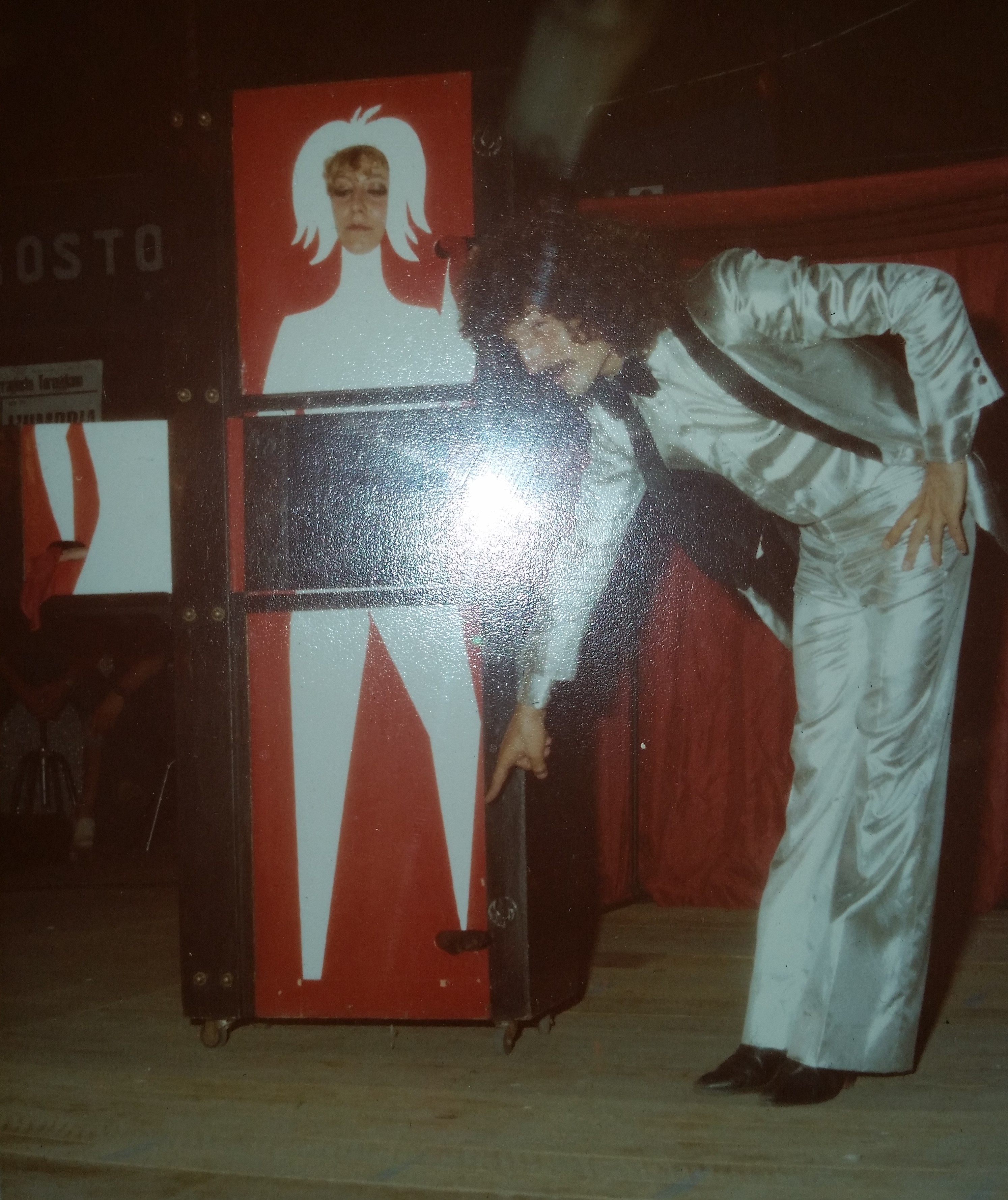
Zig Zag girl
To make a living, Haldin worked at the arms factory in Terni, where mechanics became a daily practice.
Those days were not only work: they were training.
Every gear, every lock, every chain encountered helped refine the knowledge that, one day, would be useful to him to face the impossible.
But work was not only discipline. Haldin always found a way to have fun.
Among gears, tools and locks, he loved to play small pranks: he moved objects from one colleague's pocket to another's, creating daily mysteries that made those looking for their things smile or despair.
Inevitable: when someone lost something, everyone turned to him, even if it wasn't his fault. And he, naturally, opened forgotten padlocks or lost keys, showing a mastery of mechanisms that, years later, would prove fundamental for his feats.
There was also a game that required absolute precision. A mature worker, Mario, sat on a wooden stool, always fearful of small pranks.
Haldin secretly inserted a metal tracing tip on the edge of the stool, and an accomplice, passing by, gave a slight kick with his foot, simulating that the tip had stuck into the stool.
Mario, turning around, saw the tip a few centimeters from him and Haldin, satisfied, observed his reaction. "Listen," Mario once told him, "I know you're very good... but what if you make a mistake?"
These were playful episodes, but also exercises in precision, timing and control of tension. Small daily trials that, years later, would find meaning in the extreme theater of his art.
Among the episodes of those years, one in particular helped convince Haldin that escapology would become his natural language.
In the factory there were specialized departments for every type of processing, and among these there was also the carpentry shop.
In that department, the wooden crates used to pack and ship weapons and their components were built.
They were sturdy crates, designed to withstand long journeys.
One day Haldin happened to be there. Between jokes, the workers challenged him: to get inside one of those packing crates. He accepted without hesitation. He got inside and the lid was carefully closed over him. The carpenters began to nail it with long nails, struck decisively with hammer blows.
When they finished the work, the crate was perfectly sealed. It was almost lunchtime. The workers, amused, told him they would return after eating to free him.
From the carpentry shop to the canteen there was a long stretch of road to walk, and no one was in a hurry.
When they arrived at the canteen, however, the surprise was total: Haldin was already there. Sitting quietly at the table, he was eating as if nothing had happened.
Even today, when he meets some of the older workers from those years, that episode inevitably comes up in conversation. And every time someone recalls with amazement that crate closed with nails... and the man who got out even before lunch break was over.
The experience of the packing crate at the factory inspired Haldin to transform it into a stage act. He had a similar crate built, where the audience could close and check every detail: they nailed the lid, checked that everything was in order.
To increase the difficulty, the crate was then wrapped in a sturdy cloth fastened with leather straps and surrounded by chains closed with padlocks. This number often closed his shows and was decisive in consolidating his vocation for escapology.
Meanwhile, Haldin studied Houdini. He read everything about the man who had become a myth, and in particular his most extreme feats: among these, having himself thrown from a bridge into a river handcuffed and chained.
That scene remained etched in his mind. It would be his first feat.
Meanwhile, in his shows, Haldin also introduced escapes from handcuffs and ropes.
Those years, full of ferment and experimentation, inspired the project for the most difficult challenge: to reproduce Houdini's feat, but in the icy waters of the Marmore Falls, in the heart of winter.
He knew that Houdini had chosen the month of November, with already low water temperatures. Haldin decided to go further: December, when the cold would be almost extreme.
The idea was ambitious: to organize a press conference, challenge journalists to become protagonists, bringing handcuffs, chains, ropes and anything else that could be used to imprison him.
In the meantime, he continued to practice: freeing himself from bonds was the lesser problem. The real difficulty would be the immersion underwater, with temperatures near freezing, without expert help.
Each training session was calibrated: apnea, resistance to cold, simulations of thermal shock.
He immersed himself in a concrete tank filled with well water, starting slowly and gradually increasing duration and depth.
The goal was to accustom the body to an extreme scenario: thermal shock, fainting, cardiac arrest, muscle failure. Everything had to be foreseen. Everything had to be tested.
1977 arrived. The press conference received great feedback: the city spoke of the "madman" who wanted to attempt the impossible at the Marmore Falls. The people of Terni knew well the danger of those waters even in the height of summer. Yet the risk seemed to attract everyone.
Meanwhile, a group of speleologists had set up a system of ropes and pulleys: first, Haldin would be lifted by the feet and turned upside down; then transported to the center of the waterfall, and finally thrown into the water.
Everything seemed ready... when the injunction from the Terni Police Headquarters arrived.
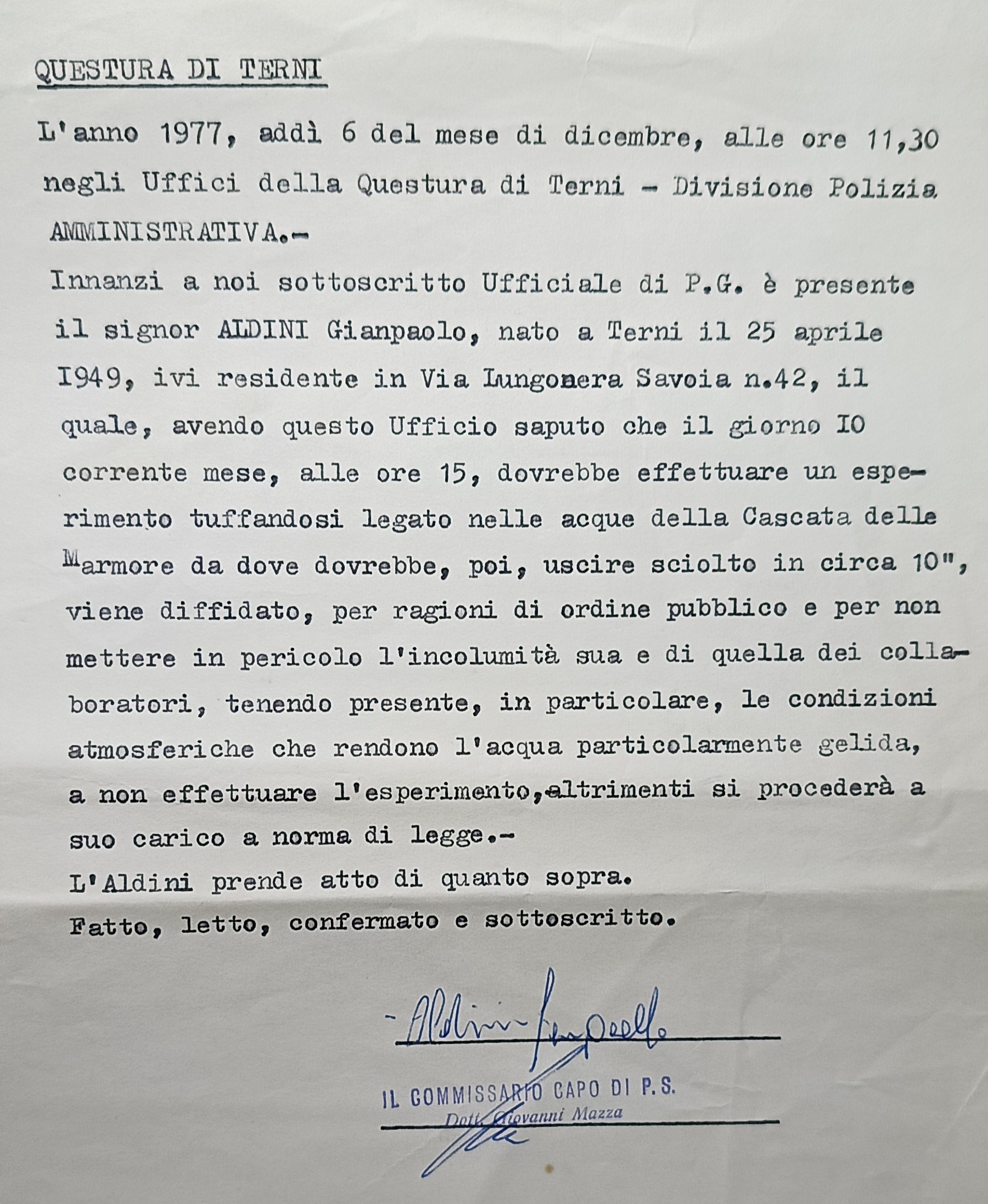
the police injunction
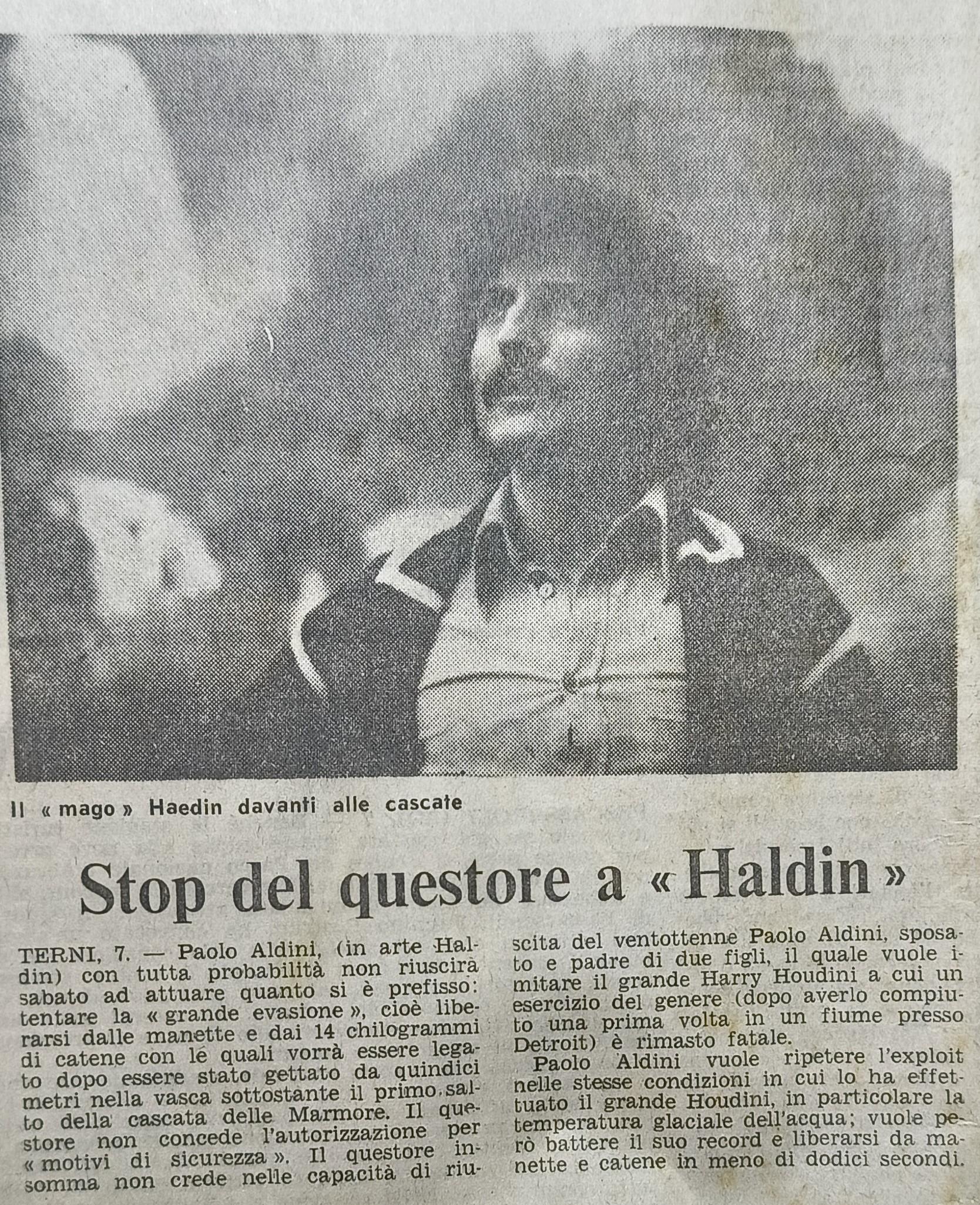
newspapers...
The Police Chief explained to him that the feat was extremely risky and that the authorities had a duty to prevent the worst.
Haldin, then practically unknown, could be seen as the "madman of the moment".
During a meeting, the Police Chief listed all the difficulties: a couple of handcuffs would be enough and the outcome would be fatal.
To end the discussion, he ordered a policeman to put his hands behind his back and close the handcuffs.
Haldin remained still, feeling the pressure of the irons on his arms, the weight of responsibility and the adrenaline rising.
In an instant Haldin placed the handcuffs, still closed, on the table in front of the Police Chief: infinite moments of silence... "Ué guagliò, nun saccio che dì", said the policeman, and the permit was signed.
With it came also the prescriptions: a doctor on the tank, an ambulance, four divers ready to intervene.
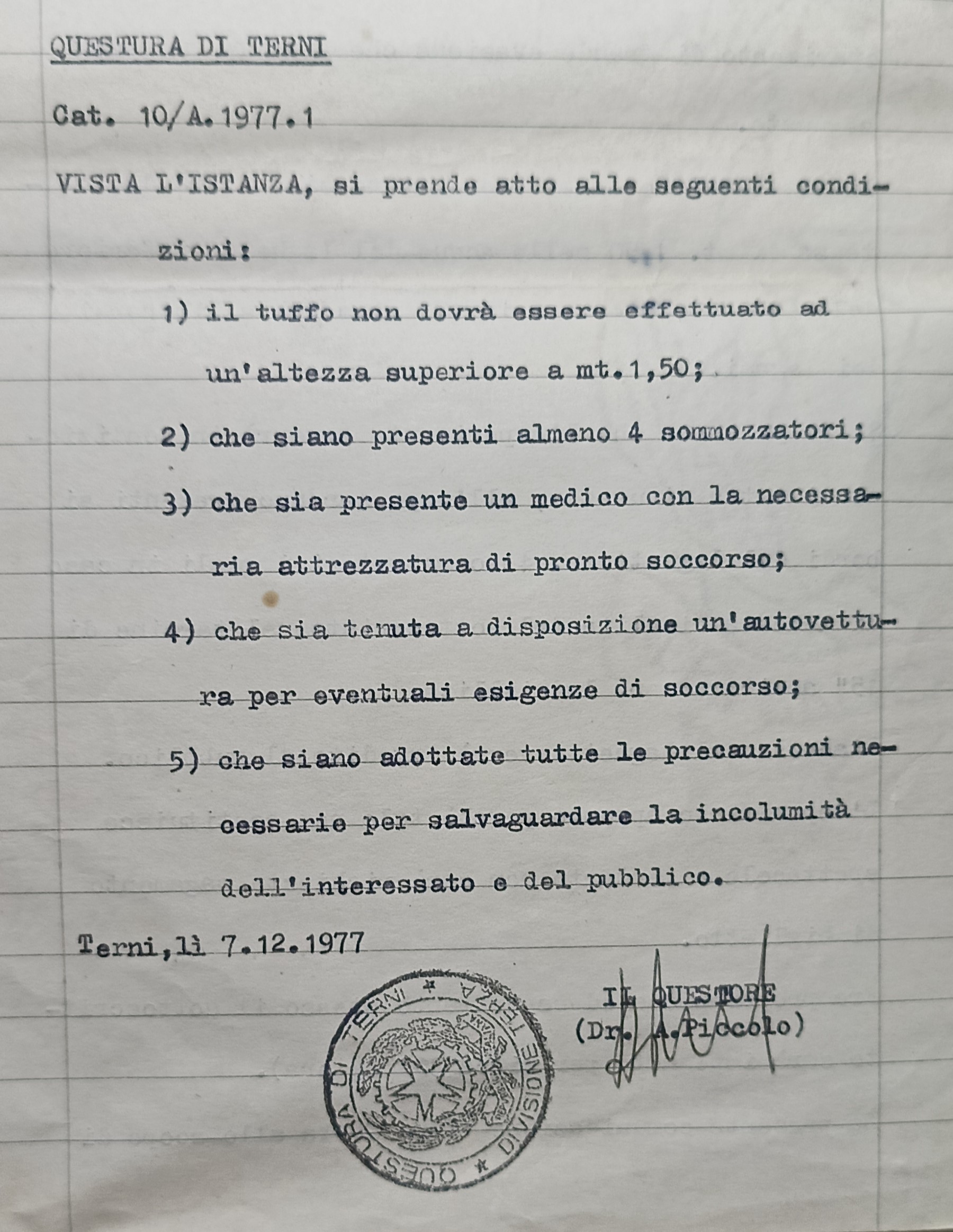
the police conditions
In the days leading up to it, the Marmore Falls was no longer just a natural spectacle: it was becoming the stage of an event awaited by everyone.
RAI had announced a live television broadcast, and people spoke of the feat as something unrepeatable.
It is said that women with hairdresser appointments decided to postpone them, just to be able to watch the show on TV.
Interest also grew for the police injunction: the newspapers followed every update, emphasizing the real risk of the feat. The injunction was proof that Haldin was not performing any theatrical gesture: he was challenging danger, testing body and mind, and the entire city perceived its importance.
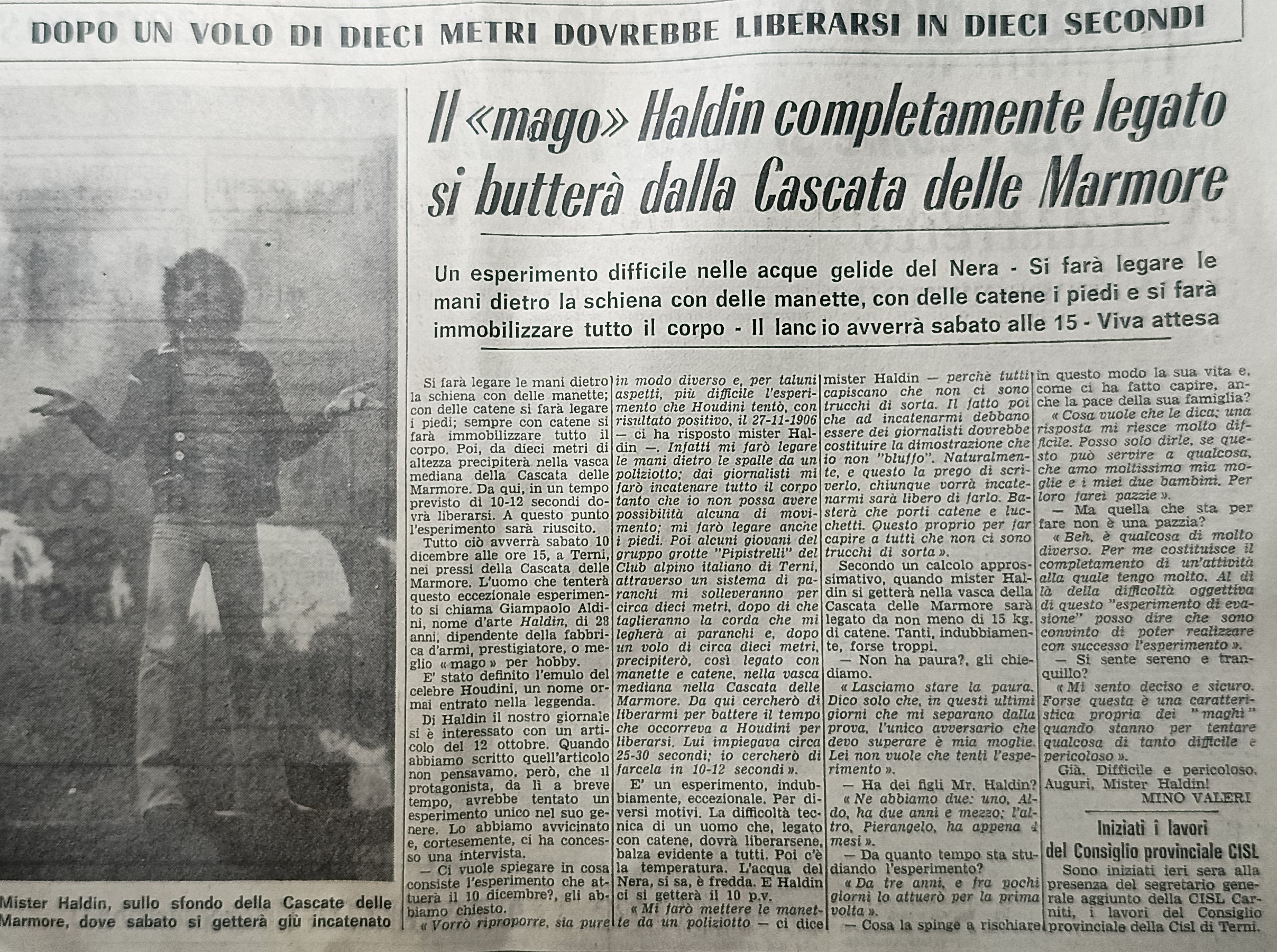
the press...
Everything was ready. Art and preparation had been tested, the risk assessed, the body hardened. Only the waterfall, the ice and the jump into the impossible remained.
December 10, 1977, 2 PM
The morning was calm in the family, an apparent normality that contrasted with the tumult that was about to break out. Haldin already had his two children: Aldo, two years old, and Pierangelo, only five months old.
Lunch would have been skipped; instead, a large breakfast rich in sugars, energy ready to be spent against the ice of the waterfall water. He would rely on those calories until the last moment.
Tilde was tense, more worried than ever. Haldin was too, perhaps even more, but he tried to show confidence: the escapologist's profession required mastery, and it was not the time to show hesitation.
He had chosen a simple outfit: trousers and shirt, with a light gilet over them, practical and without frills, the only compromise between comfort and visibility.
Meanwhile, preparations were underway at the waterfall. The divers immersed themselves in the main pond where he would be thrown, studying currents, obstacles and depths.
The coordinator's phone call arrived on time: murky waters, zero visibility, bottom full of mud and uprooted plants. It would be essential to avoid reaching the bottom. He was suggested to wear something phosphorescent, but it was too late to change clothes.
Only one certainty remained: avoid the bottom.
Under the house, the journalists amplified the sense of reality of what was about to happen. They moved nervously, took photos, recorded interviews. Someone had also arrived carrying handcuffs and chains, ready to personally contribute to the test.
A friend reached him by car. Haldin and Tilde headed towards the waterfall.
The scene that appeared along the seven kilometers of road was almost surreal: people everywhere, cars blocked, a crowd walking just to arrive. Police intervention with sirens blaring was necessary to allow passage.
On site, the panorama was impressive. The mountains surrounding the waterfall swarmed with spectators. In that instant Haldin doubted he had created something bigger than himself. The fear was no longer about handcuffs or the icy water. It was the crowd. The responsibility of satisfying that expectation weighed more than any chain.
Arriving on foot at the edge of the pond, with the cold, sharp air and the noise of the waterfall covering the voices, he greeted the doctor who offered him more sugar. He accepted. He greeted the divers already in the water and the collaborators.
Then, with a gesture that was confident only in appearance, he invited the journalists to proceed with the bindings.
Among them, a man came forward who turned out to be a policeman. He put the handcuffs behind his back. Haldin felt the metallic click.
Good. Food for his teeth.
The chains arrived. As they wrapped him, he mentally estimated the weight, observing every movement. They secured them with several padlocks, wrapping him like a salami.
In his mind, one thought hammered: avoid the bottom.
A detail that was almost ironic crossed his mind: he hadn't told the journalists that all that material would remain down there.
He estimated about five kilograms of weight. It was within the calculations.
Then a man approached with a briefcase. He introduced himself as a journalist. He checked the bindings, opened the briefcase and pulled out a diver's belt loaded with lead. He fastened it around his waist, tightening it as much as possible; he was impressed by the lucidity and coldness with which he carried out the operation.
Eight kilograms. Five plus eight: thirteen. Too many!
In that instant Haldin changed strategy. The thirty seconds planned between impact and resurfacing were no longer sustainable. He would immediately begin to free himself, eliminate the weight and resurface in the shortest possible time.
They laid him on a trolley, tied his feet and hoisted him over the big tank. He was pulled to the center. A suspended moment.
The rope operators were his technicians. Everything agreed.
Oxygenation. Hyperventilation. Relaxation. Final check.
He gave the signal. Release. Water. Underwater.
The cold was a dry blow. No hesitation. He immediately began to untie, freed himself from the weight, pushed upward.
Only later did he realize he had accelerated too much. He had acted with almost furious speed. Nine seconds.
He was already out, breathing.
On board the tank, a tent had been set up to change, but now he no longer felt the cold. Adrenaline had erased everything. He looked for Tilde.
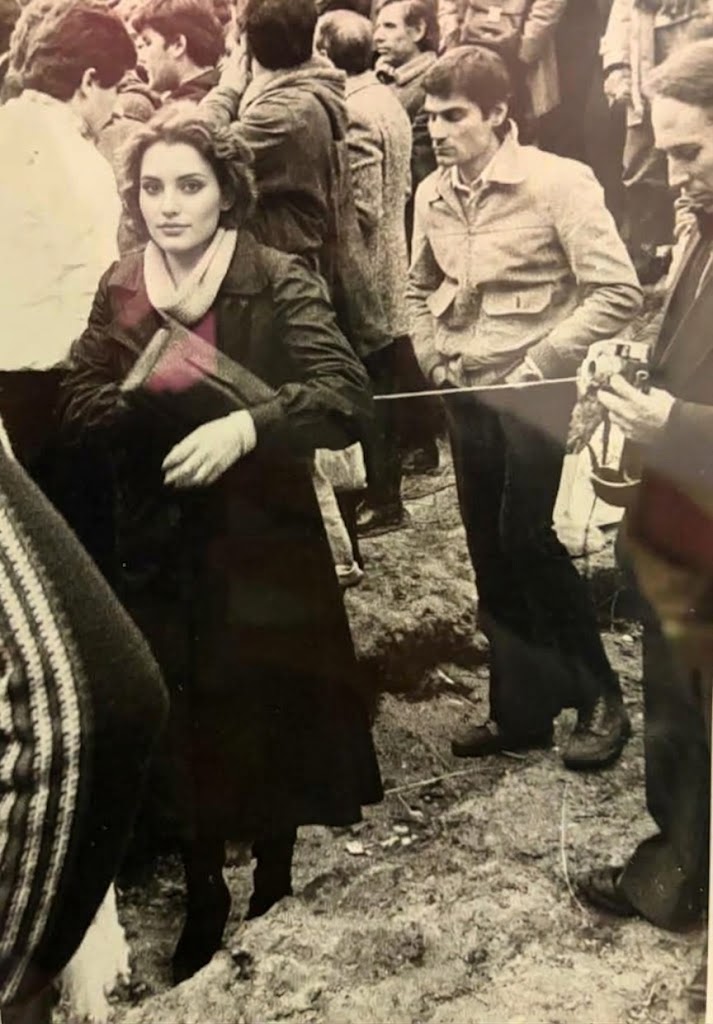
Tilde...
He found her in the crowd, her eyes shiny. He hugged her for a long time. In that moment he understood how much he had made her suffer.
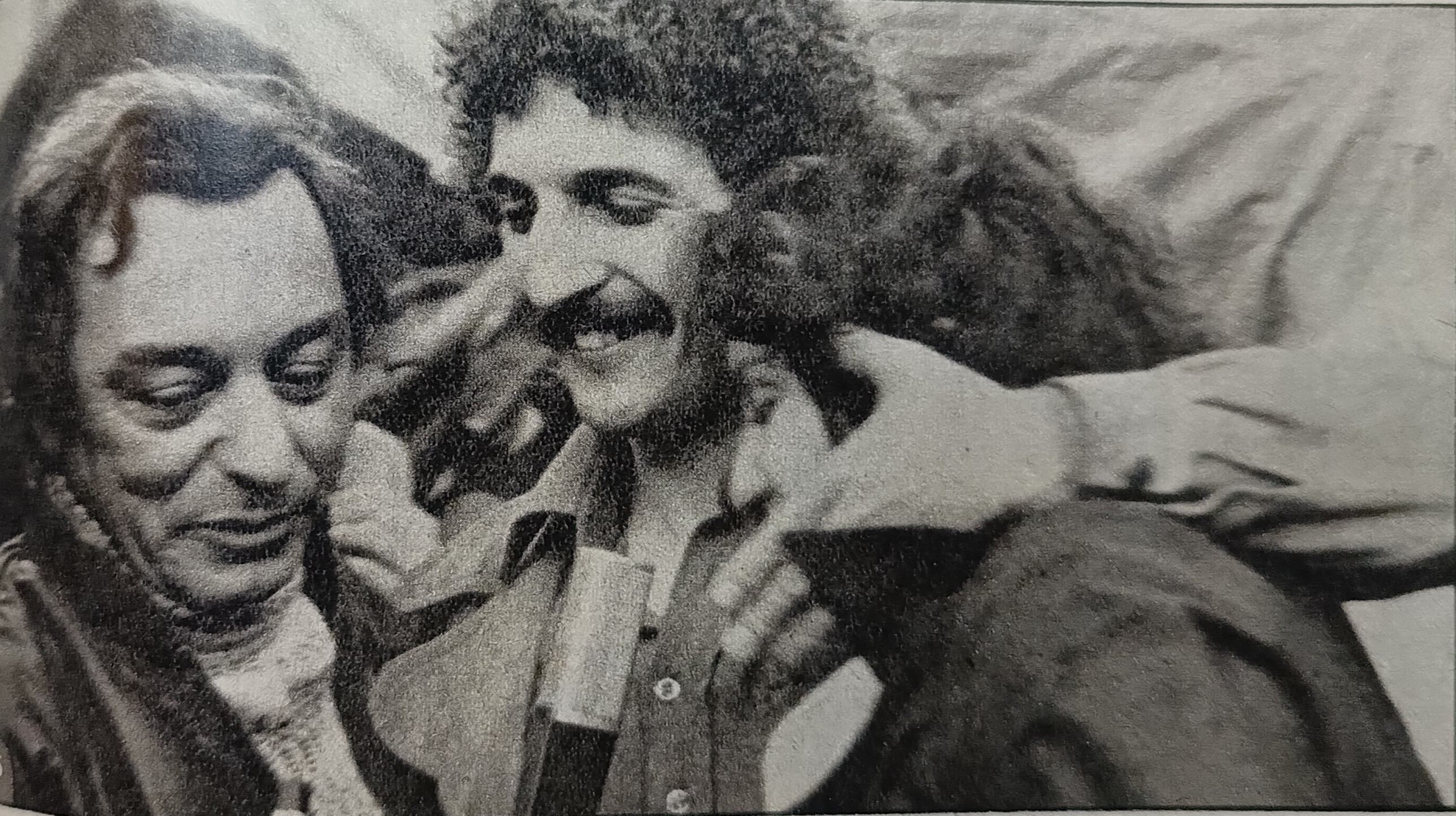
Tilde...
For a moment there was almost silence. Then the mountains seemed to catch their breath. A long, endless applause echoed among the rocks.
He thought of his parents and his brother, who had followed the live TV broadcast. Those nine seconds, for them, must have been an eternity.
He had understood how much weight the trust of others can carry.
In the following days he had the opportunity to thank the people of Terni, to whom he remained always grateful for their sincere participation and for having transformed a personal challenge into a collective event.
That day he had not only challenged the icy water, he had challenged himself.
— end of chapter —
Between factory and stage
Edoardo Brenci...
December 10, 1977 marked a turning point.
Going around, people recognized him, greeted him, complimented him. Impresarios began to call to propose and sell his show; the press and television showed increasing interest.
He could no longer be the amateur magician, even if he was good. He felt all the responsibility of that unexpected notoriety: he had to prove he deserved it. The leap from unknown to professional was challenging.
While maintaining his job at the factory, he began to organize himself with greater rigor. Among the proposals received, there was one for the summer of 1978: a series of evenings included in an initiative called "L'Umbria Canta". It was a sort of traveling singing contest that touched various Umbrian towns; he closed each show as the main attraction.
He accepted also because he wouldn't have to travel too much: he stayed in his region, a convenient solution at that time of transition.
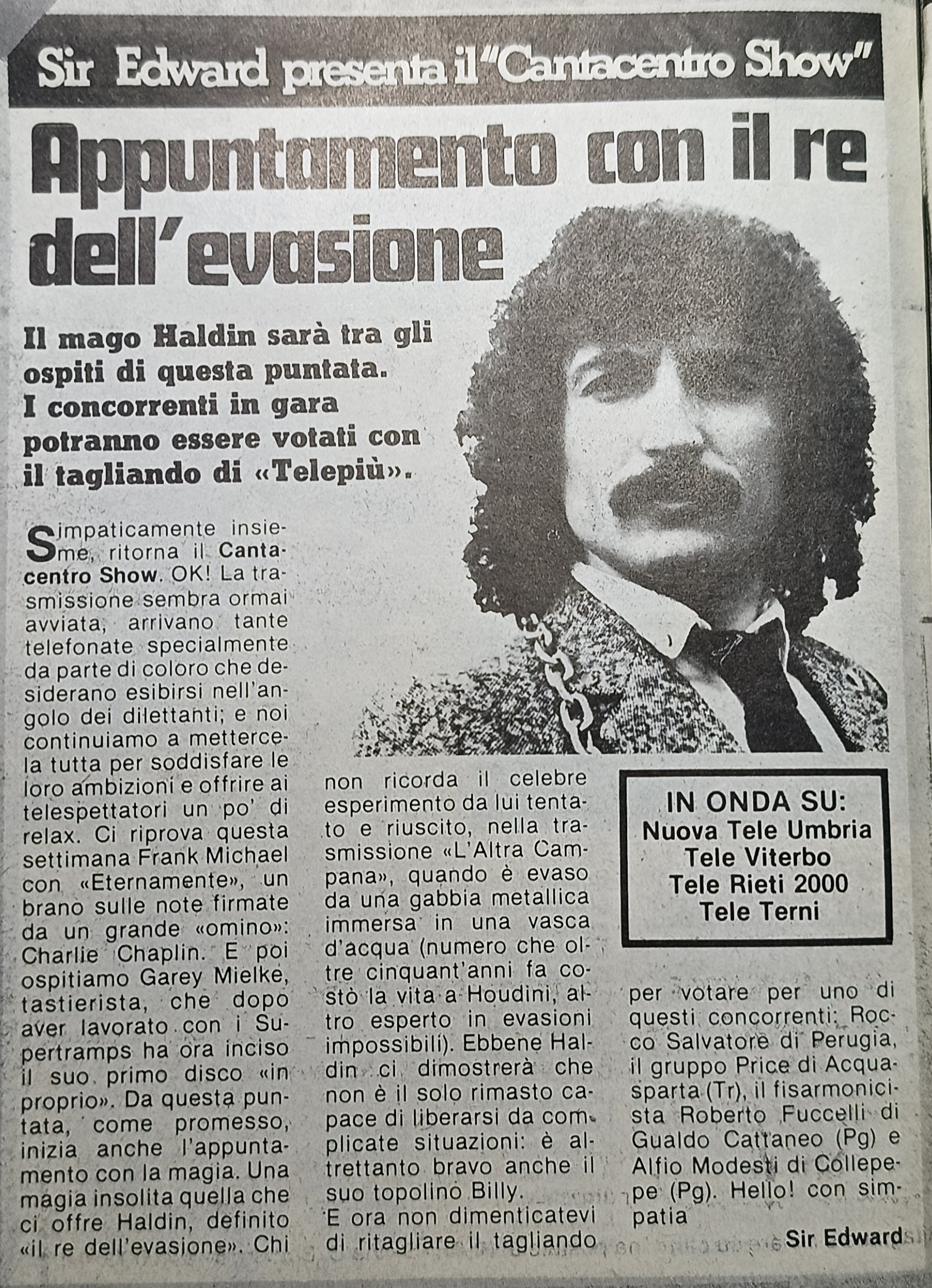
Umbria canta...
The organizer and presenter was Edoardo Brenci. He was an important figure, not only professionally but also humanly. A capable and determined person — today president and promoter of the Teatro della Concordia, known as the smallest theater in the world — Brenci immediately understood the potential of that artist who was emerging.
Aware of the work ahead of him — devising new acts, preparing, performing in the evenings and continuing his factory shift — he could not also take care of promotion. From that moment on, Edo took care of it. He handled contacts with theater agencies, impresarios, the press and television, followed promotional material and organization. As stubborn as he was, he went to Rome, knocked on the doors of television shows and always came back with some engagement. An invaluable collaboration.
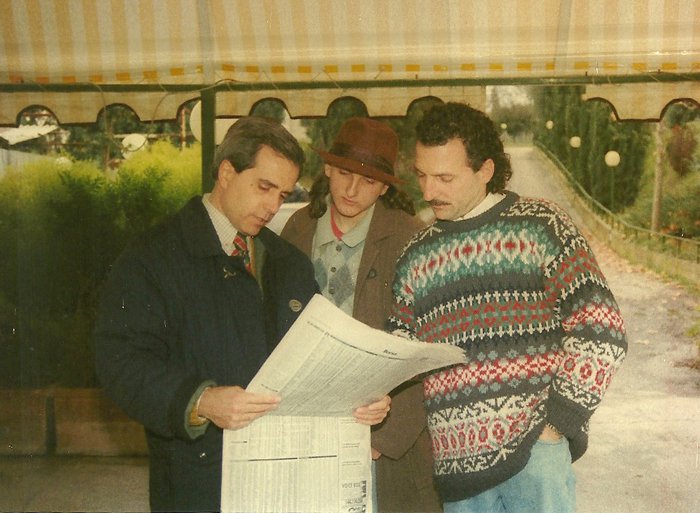
Edoardo Brenci...
While he was engaged in the L'Umbria Canta tour, his mind was already projected beyond. Every night, after finishing a show, he thought about the next challenge. Once again, Harry Houdini was the reference point.
Among all his feats, there was one that fascinated him more than any other: the famous Chinese Water Torture Cell, the water tank to which, according to legend, the death of the great American escapologist is also linked.
The idea of facing such a test began to slowly transform into a concrete project. He knew that months, perhaps years, of study and preparation awaited him. He did not yet know how long he would have to remain in apnea, but he was certain of one thing: he would have to have the time necessary not only to free himself, but also to maintain an essential safety margin.
The first problem was building the tank. It had to hold about six hundred liters of water, be perfectly transparent, extremely robust and, above all, absolutely safe. There could be no risk of such a structure giving way during a show, perhaps on a stage full of electrical equipment or, worse, in a television studio.
It was necessary to approach the problem with an almost engineering method. Haldin personally designed every detail: dimensions, thicknesses, materials, reinforcement points and support systems. Once the project was completed, he began the search for someone capable of turning it into reality.
After numerous attempts, he finally found a company in Rome specialized in plexiglass processing. Together with the technicians, an innovative solution was studied: the tank would be obtained from a single sheet of plexiglass fifteen millimeters thick, bent while hot until it took on a cylindrical shape. The ends would be welded and further reinforced with safety overlays; the same procedure would be used for the bottom, while the entire structure would rest on a rigid but slightly elastic base, capable of absorbing stresses.
The tank's support also required careful study. Full of water it would reach a considerable weight and the load had to be distributed on the floor so that it could work safely both in theaters and on outdoor stages, which were often lacking any structural certification. It was not uncommon for technicians to have to reinforce the stage with special supports before starting the show.
But Haldin was not yet satisfied. He wanted the audience to fully perceive the difficulty of the feat. For this reason, he decided to add a further complication: a sturdy metal cage in which he would be locked before being immersed in the tank.
He did not want to use padlocks or locks. He feared that someone might think of the existence of hidden keys or some trick. The solution was extreme: the cage lid would be electrically welded in front of the spectators. Carrying out this delicate operation would be Sergio Caponi, Haldin's friend and a welder at the Terni Arms Factory.
One problem remained. The cage had to be turned upside down with Haldin already inside, so that he entered the tank headfirst. A tilting structure was therefore designed that allowed the entire cage to be rotated in a controlled manner. Subsequently, it had to be lifted to over six meters in height using a large structure equipped with a track and pulley, translated exactly above the tank and finally lowered into the water.
Every detail was built, tested, modified and retested. Once again, the factory worker friends were fundamental, men of extraordinary experience and manual skill, true artists of metal. Among all, Giuseppe Cardinali, known as "Peppino", a welder and carpenter of exceptional abilities, who built most of the necessary structures.
While the equipment was taking shape, physical preparation also began. The first apnea attempts were anything but encouraging. After just forty seconds, the need to breathe became unbearable. Maurizio Pesciaioli, a friend and expert freediver, then entered the scene and began to follow him in training.
For almost two years they spent hours and hours on the edge of a pool, experimenting with breathing techniques, hyperventilation and relaxation. The results came slowly: first ninety seconds, then a little more. But it was still not enough.
Haldin's lung capacity was absolutely normal, certainly far from that of great champions like Enzo Maiorca. It was therefore necessary to learn to consume less oxygen. The breakthrough came thanks to autogenic training. Through intense mental work he learned to completely relax his muscles, reducing energy consumption, and even to voluntarily lower his heart rate. Even small adjustments helped to gain precious seconds: even keeping your eyes closed reduced oxygen consumption.
Over time he reached two and a half minutes. Maybe that would have been enough, but Haldin wasn't trying to succeed: he was trying to be safe.
Those who have never faced such tests can hardly understand the conflict that breaks out when the body desperately demands air. Every instinct pushes you to interrupt the apnea, while the mind must continue to maintain control. It is a struggle against oneself, against the most natural of impulses: to breathe.
Experience also taught him a small secret. He had learned to voluntarily provoke the pulmonary contractions that normally appear in the final moments of apnea. Each contraction stirred the residual air in the lungs, allowing every last trace of available oxygen to be used. In the end, he reached three minutes. With constant training, the limit rose to three minutes and fifteen seconds.
It was time to move from theory to reality. The challenge with the water tank could finally begin.
— end of chapter —